Wildfires

Mexico

In a wildfire, what kills most people isn't the fire — it's the smoke. And smoke reaches entire cities hundreds of kilometers from the flames. Here's how to set up a clean air room in your home, which mask actually works, and how many meters of cleared space the standard calls for around your house.

Updated on September 9, 2026
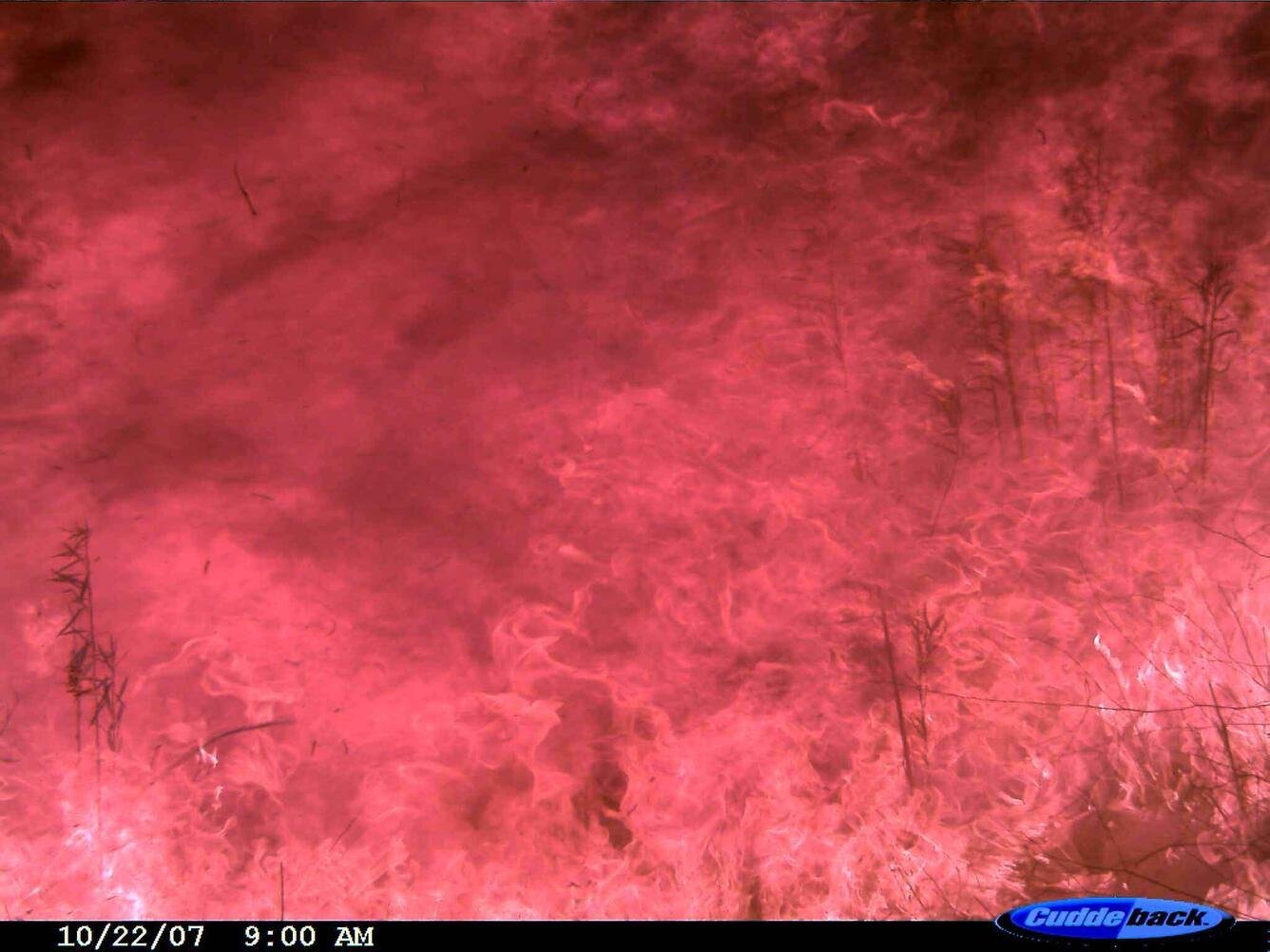
Llamas de alta intensidad avanzando por matorral durante los incendios del sur de California de 2007.
Llamas de alta intensidad avanzando por matorral durante los incendios del sur de California de 2007.U.S. Geological Survey · Dominio público

Before the crisis

Defensible space. CAL FIRE divides the land around a house into three zones with exact distances. It's the single most effective measure for a home to survive a wildfire:

Zone 0 — 0 to 1.5 meters (0 to 5 feet) from the house
Only non-combustible materials. No stacked firewood, dry potted plants, fiber doormats, plastic furniture, or vegetation touching the wall. This is the strip where a single ember decides whether the house survives.
Zone 1 — up to 9 meters (30 feet)
Remove dead grass and plants. Prune branches to within 3 meters of chimneys and flues, and space tree crowns 3 meters apart to break up fuel continuity.
Zone 2 — 9 to 30 meters (30 to 100 feet)
Grass cut to 10 cm or less. Firewood is stacked with 3 meters clear all around, down to bare soil.

Set up the clean room before smoke arrives. The EPA explains how: pick a room with few windows and doors, keep them closed, and run a portable air cleaner or your central system with a MERV 13 or higher filter in recirculation mode. Inside that room, no smoking, no cooking with gas or wood, no candles, and no aerosols — all of that dirties the air you're trying to clean.

  • Keep NIOSH-approved N95 or P100 respirators on hand for every adult, bought before fire season.
  • Store documents, medication, and irreplaceable items in a box you can grab and go with in two minutes.
  • Agree on and memorize two evacuation routes out of your neighborhood, in case one is blocked.
  • Keep your vehicle's gas tank above half during fire season.
  • Don't burn trash in yards or vacant lots, and don't throw lit objects into areas with vegetation — this is CENAPRED's explicit recommendation, because most wildfires are human-caused.
Official sources for this section

During the crisis

Respiratory protection: what works and what doesn't.

  • The CDC recommends a NIOSH-approved N95 or P100 respirator, well-fitted to your face. Facial hair breaks the seal, and without a seal there's no protection.
  • Cloth and surgical masks don't filter the fine particles in smoke. They're useful for other things, not this.
  • For children, the CDC notes they can be used starting at age 2 with careful attention to fit; for infants, protection means keeping them indoors with clean air.
  • Before you're exposed, check the air quality index on your country's official site or at airnow.gov, and follow the authorities' instruction to stay indoors.

How to read the Air Quality Index (AQI). This is the number that decides whether you go outside today:

0 to 50 — Good
Minimal risk to the public.
51 to 100 — Moderate
Risk for unusually sensitive people.
101 to 150 — Unhealthy for Sensitive Groups
People with asthma, COPD, heart disease, pregnant people, children, and older adults should limit outdoor exertion.
151 to 200 — Unhealthy
The general public may begin to notice effects. Reduce outdoor activity.
201 to 300 — Very Unhealthy
Health alert for everyone. Use your clean room and go outside only when essential.
301 or higher — Hazardous
Health emergency alert for the entire population.
Official sources for this section

After the crisis

  • Don't go back until authorities say it's safe: there can be active hot spots, unstable trees, and cut utilities.
  • Keep your clean room running: smoke can linger for days after the fire is out.
  • Wear an N95 and gloves to clean up ash, and dampen it lightly so it doesn't become airborne.
  • Don't run fans that pull outside air indoors while the air is still dirty.
  • Photograph all the damage before cleaning up, and keep the receipts for what you spend — you'll need them for insurance and aid programs.
  • If anyone in the household has asthma or lung disease and gets worse, see a doctor: smoke exposure has effects that can show up days later.
Official sources for this section

Family plan

  1. Two evacuation routes, not one. Fires cut off roads. Every adult in the household should be able to name both without looking at a map.
  2. A meeting point outside the area. Far enough away that it won't fall inside the same evacuation perimeter.
  3. The go-bag. Documents, medication, chargers, a change of clothes, and your N95s. Packed at the start of the season, not the night of the fire.
  4. Who gets whom out. Older adults, people with reduced mobility, and pets each assigned to one specific person.
Official sources for this section

Food and water

How to store it so it works when you need it
The CDC calls for approved food-grade containers with a tight-fitting lid, made of a sturdy, unbreakable material —never glass— and with a narrow mouth for pouring. An explicit warning: never use a container that has held toxic chemicals such as bleach or pesticides. And what almost everyone forgets: stored water should be replaced every 6 months. To disinfect the container before filling it, use a teaspoon of unscented household bleach per liter of water, wait 30 seconds, and pour it out.
What food to keep on hand
Ready.gov recommends several days of non-perishable food and gives a concrete list: ready-to-eat canned meats, fruits, and vegetables —and a can opener—, protein or fruit bars, dry cereal or granola, peanut butter, dried fruit, canned juices, and pasteurized long-life milk. The rule when putting it together is simple: food your family will actually eat, that needs no cooking, and that you can rotate before it expires.
  • Keep the refrigerator and freezer closed: every time you open one, you waste hours of stored cold.
  • Throw out any food that has touched floodwater, even if the container looks intact. This is an explicit Ready.gov instruction.
  • Keep a manual can opener. It is the item people forget most, and without it your pantry is useless.
  • If you buy bottled water, keep it sealed in its original container, in a cool, dark place.
Official sources for this section

Power and communications

When the cell network is overloaded: text, do not call
The joint FCC and FEMA guide explains why: "text messages may get through when your call does not", even if delivery is delayed when the network is congested. And it asks for something almost no one does: "limit non-emergency calls", because every call takes up space that emergency communications need. Also save a contact under the name "ICE" (In Case of Emergency), the convention rescue personnel look for on someone else's phone.
How to stretch your battery
The same guide recommends lowering screen brightness and turning off apps to conserve charge. In an emergency your phone stops being entertainment and becomes your only line to the outside world: treat it like your water supply.
The battery-powered radio is still irreplaceable
The FCC and FEMA recommend a battery-powered radio or a portable television to follow emergency bulletins during power outages. It is the only channel that depends on neither your electricity nor the cell network.
The alerts you already have and did not know about
In the United States, Wireless Emergency Alerts are free messages that go straight to your phone for severe weather, AMBER alerts, and threats to safety in your area. Two things worth knowing: you do not need to sign up —phones have supported them since 2012— and they are not affected by network congestion, so they get through when calls no longer do. Find out what the equivalent system is in your country, and do not mute it.
  • Have at least one light source that does not depend on the grid: a battery-powered or hand-crank flashlight, or a rechargeable lamp.
  • Charge phones and backup batteries before the forecast event arrives, not after the power is already out.
  • Keep a list of important phone numbers on paper: if your phone dies, your contacts die with it.
  • Agree with your family that after an emergency everyone texts the same contact instead of calling each other.
Official sources for this section

Health and special needs

This is the section that decides who has a hard time and who has a dangerously hard time. An emergency does not suspend diabetes, high blood pressure, pregnancy, or dependence on an oxygen concentrator: what gets cut off is access to the pharmacy, the clinic, and electricity. Everything that follows needs to be prepared beforehand, because once the emergency hits, there is no more room.

  1. Keep a reserve of your medications, and know which ones hold up. Ready.gov calls for a several-day supply of prescription medications. For those that need refrigeration, the CDC is blunt: once the power has been out for a day or more, discard any medication that requires refrigeration, unless its label says otherwise.
  2. The insulin exception, worth knowing word for word. The FDA documents that insulin in the manufacturer's original vials or cartridges —opened or unopened— can stay unrefrigerated between 15 and 30 °C (59 and 86 °F) for up to 28 days and still work. It loses effectiveness at extreme temperatures, and the longer the exposure, the less effective it becomes. In an emergency "you may still need to use insulin that was stored above 30 °C" —that is better than not using it at all— but as soon as proper storage is available again, those vials should be discarded and replaced.
  3. If someone depends on electric medical equipment, there is one step almost no one takes. Ready.gov says it explicitly: you can ask your power company to put you on a priority list for service restoration. That step is free, can be done on any ordinary day, and changes the order in which you get reconnected. Add a backup battery for an electric wheelchair and for any assistive device, and talk with your doctor about how to keep the equipment running during a power outage.
  4. Keep a copy of medical information, not just the pills. A list of medications with dosages, allergies, diagnoses, doctors' contact information, and —for infants— the vaccination record. A prescription bottle cannot always be refilled at a pharmacy in another city; a written list can solve that.
Pregnancy and newborns
The CDC calls for prenatal vitamins and other medications in the kit, plus supplies in case delivery happens without being able to reach a hospital: clean towels, clean sharp scissors, a bulb syringe, gloves, two clean white shoelaces to tie the cord, clean sheets, sanitary pads, soap or alcohol, and garbage bags. For infants: diapers, wipes, ointment, bottles, and formula. One detail that matters: ready-to-feed formula is the safest option in an emergency, because it does not need to be mixed with water and comes in sterile, single-use containers.
Disability, reduced mobility, and older adults
Ready.gov stresses planning accessible transportation in advance for evacuating or getting around, and including a service or support animal with its food, water, and supplies. That plan should be worked out with specific, named neighbors, not left vague.
The blow that comes later: mental health
The CDC names the normal reactions after a disaster —fear, anger, sadness, worry, numbness, frustration, trouble sleeping, or nightmares— and recommends taking care of your body, staying in touch with other people, and taking breaks from the news. In the United States and its territories, the Disaster Distress Helpline is available 24 hours a day: 1-800-985-5990, with service in Spanish. Asking for help here is not weakness: it is part of recovery, just like repairing the roof.
Official sources for this section

Home and belongings

  1. Before you go back in: look, smell, and listen from outside. The CDC lays it out this way: if you smell gas or suspect a leak, shut off the main valve, open all the windows, and get out immediately. If there is standing water inside and you can cut the power from a dry spot, do it. And one simple warning that prevents explosions and fires: use battery-powered flashlights, not candles, gas lanterns, or torches.
  2. Ventilate before you settle in. The CDC recommends going in briefly to open doors and windows, and letting the house air out for at least 30 minutes before staying inside.
  3. Shutting off utilities: when to do it, and the mistake you cannot make. Gas has a rule with no exceptions: if you shut it off for any reason, only a qualified professional can turn it back on. Never turn it back on yourself. Electricity is shut off by switching off the individual circuits first and the main breaker last —the order matters, because an electrical spark can ignite gas if there is a leak—. Water should be shut off if pipes may have cracked, because that contaminates the house supply, and should not be turned back on until authorities confirm it is safe to drink.
  4. Go back only when authorities say it is safe. It sounds obvious, and it is the instruction people break most often: go back home only when authorities say it is safe. Structural damage is not always visible from the street.
  • Make a photo inventory of what is in each room today: it takes twenty minutes and is worth its weight in gold for a claim.
  • Keep that inventory and your policies outside the house —in the cloud or with a family member— because a file that gets soaked along with the house is useless.
  • If you have to leave, take your documents with you, not your furniture.
  • Do not sign anything with a contractor while you are in shock: check the money section for the warning signs of fraud.
Official sources for this section

Money and income

The documents you need to protect today
The official recommendation is to keep insurance policies, deeds, property records, and other important papers in a safe place outside the house. FEMA publishes the Emergency Financial First Aid Kit for this, organized into four sections: household identification, financial and legal documentation, medical information, and contacts. Its rule for paper: a fireproof and waterproof box or safe, a bank safe-deposit box, or in the hands of someone you trust. For digital files: password-protected files on an external drive or in secure storage outside the home. And if you pay everything online, print your account records periodically.
An emergency fund, even a small one
The CFPB avoids magic formulas: "the amount you need depends on your situation", but "even a small amount can provide some financial security". Its underlying argument is the one that matters: without that cushion, a single unexpected expense can grow far larger than the original bill through interest and fees, because it forces you to rely on credit.
Official sources for this section

Economic opportunities

Adaptation and income
Time to start: Days

Debris hauling and furniture moving

Taking debris, ruined furniture and damaged appliances to the collection point set by the city, or moving belongings somewhere dry, is one of the first needs and one few can meet without a vehicle.

Estimated investment: USD 0–200 Difficulty: baja Vehicle needed Tools needed
Time to start: Days

Soot and smoke-odour cleaning

After a fire many homes and shops are still standing but full of soot and odour. Cleaning walls, ceilings, clothes and ducts makes them usable again.

Estimated investment: USD 80–400 Difficulty: media Vehicle needed Tools needed
Time to start: Days

Clearing fallen branches and trees

After high winds, yards, pavements and driveways are blocked. Cutting, sectioning and hauling away is among the first things hired.

Estimated investment: USD 60–600 Difficulty: media Vehicle needed Tools needed

These are possibilities, not guarantees. Results depend on location, demand, competition, capital, skills and each person’s circumstances.

Filter the income possibilities by your situation. Results are starting points to research locally, not personalised advice. What can I do?

What you can sell

Adaptation and income

In a wildfire, demand arrives in three waves: clean air while smoke covers the area, cleanup once people can return, and prevention ahead of the next season, which is the most neglected of the three.

  • N-95 masks and air purifiers or filters for indoor spaces while the smoke lasts.
  • Temporary sealing of windows and gaps to reduce smoke coming into homes and businesses.
  • Ash and soot cleanup on roofs, patios, cisterns, and HVAC systems.
  • Washing and recovery of textiles soaked in smoke smell.
  • Creating defensible space: clearing brush, trimming, and removing flammable material around the home.
  • Removal of burned trees at risk of falling.
Official sources for this section

Businesses and self-employment

Adaptation and income

It helps to start with one figure to size up what we're talking about: according to the ILO, informality affects nearly half of the employed population of Latin America and the Caribbean, around 47%, with huge differences between countries — under 30% in Uruguay and Chile, over 70% in Bolivia and Peru. For millions of families in the region, "looking for a job" and "starting something on your own" are the same sentence. What follows is not a promise of income: it is a map of what people actually do when a crisis hits, with the requirements and the risks laid out plainly.

Brush clearing and defensible space — the work that pays before the fire
It's the most sustainable business of this crisis because it sells every year, fire or no fire, and because insurers and local authorities often require it. Hand tools, a brush cutter, gloves, and eye protection. Offer it by season to whole neighborhoods in the wildland-urban interface: selling ten houses on the same street costs the same as selling one.
Indoor ash and soot cleanup
Fire ash isn't swept dry: it scatters and gets breathed in. You need a vacuum with the right filter, damp mopping, an N-95, and gloves. One detail that sets you apart from improvised competition: cleaning the air-conditioning filters and ducts too, where soot lingers for months.
Recovery of textiles and smoke-smelling belongings
A specialized laundering service — clothes, curtains, blankets, stuffed animals — solves something people value more than it seems, because these tend to be the belongings that actually survived. You can start with home washing machines and grow into home pickup.
United States — SBA disaster loans
For areas with a declared disaster. The Economic Injury Disaster Loan (EIDL) provides working capital for affected small businesses and nonprofit organizations; the physical damage loan covers losses not covered by insurance. Combined cap of $2 million, interest not exceeding 4% if you cannot obtain credit elsewhere, terms of up to 30 years, and the first payment deferred 12 months. There is also a line for homeowners (up to $500,000) and for renters for personal property (up to $100,000).
Mexico — what actually exists today
FONDEN stopped taking on new commitments on January 1, 2021. What operates today in emergencies is PAEAN, run by Civil Protection, and it is worth knowing exactly what it is and is not: it delivers relief supplies — food kits, water, blankets, roofing sheets, cleaning materials — when a state's own capacity is overwhelmed. It is not a reconstruction fund or a loan for your business. For capital, look at state, municipal, or development-bank programs, always verifying on the official website: fraud schemes that use its name circulate around these programs.
Brazil — Pronampe for micro and small businesses
A credit line for microenterprises (annual revenue up to 360,000 reais) and small businesses (from 360,000 to 4.8 million). The amount can reach up to 60% of the previous year's gross revenue for businesses with more than one year in operation, and up to 50% for new ones. The maximum rate is the SELIC rate plus up to 6% per year.
Official sources for this section

Products and tools

Products and tools that could be useful

An orientation list to complement the information on this page. This is not a shop, and nothing here is a required purchase.

No products have been selected for this section yet.

Manuals and tutorials

PDF · manual

What-to-do manual: Wildfires

Complete PDF guide to print or carry on your phone, with official measures before, during and after, and cited sources.

Checklists and templates

PDF · checklist

Checklist: mochila de emergencia familiar

Lista imprimible para armar y revisar la mochila de emergencia de la familia.

Coming soon

Recovery stories

Real, published and verifiable cases: each one links to the source where it was documented. No made-up testimonials here.

Botania neighborhood, Viña del Mar (Chile) — the neighborhood left standing

In the megafire of February 2024, Botania's roughly 70 homes were not lost, and it wasn't luck. Before the fire the neighbors had moved trees away from roofs, cleared gutters, and removed combustible material from yards, and had equipped themselves with axes, rakes, hoes, and water backpacks. During the fire they coordinated with walkie-talkies to track the flames' advance. They took part in a community monitoring and alarm program.

What to learn from this: Defensible space gets built beforehand and as a group: a single cleared house surrounded by yards full of brush doesn't survive. And radios work when the cell network has already gone down.

Excélsior · 2024-03-01 · Botania, el barrio que se salvó del incendio más mortal en Chile

Related articles

Two fires, and what they taught.

Camp Fire, California, November 8, 2018 — speed
In Butte County. CAL FIRE documents 85 civilian deaths, more than 18,000 structures destroyed, and 153,336 acres burned. The towns of Paradise and Concow lost around 95% of their buildings. The lesson: most of that destruction happened in the first four hours. Against a fire moving that fast, the window to get out is measured in minutes, not hours, and the moment to decide is when you see the smoke, not when the order arrives.
Lahaina, Maui, August 8, 2023 — the alert and the evacuation
More than 2,200 structures destroyed and roughly $5.5 billion in damage, according to USFA's preliminary report, which ranks it the fifth-deadliest wildfire in U.S. history. The death toll was revised several times: it dropped from 115 to 97 in September 2023 after DNA testing, and in June 2024 the Honolulu medical examiner and Maui police confirmed 102. The lesson: early warning and evacuation routes matter as much as firefighting resources. A wind-driven urban fire isn't something you put out — you run from it.

Related guides on this site:

Official sources for this section

Do not wait for it to happen

Download the checklist and build your family plan today. It takes under an hour and it is what changes the outcome most.