Solar Flare

Mexico

Of all the scenarios on this site, this is the one that generates the most myths. NASA says it plainly: a solar storm does not cause you physical harm if you're on Earth. What it can affect are GPS, high-frequency radio, and, in the extreme case, the power grid. Here's the difference between what's real and what's fearmongering.

Updated on September 9, 2026
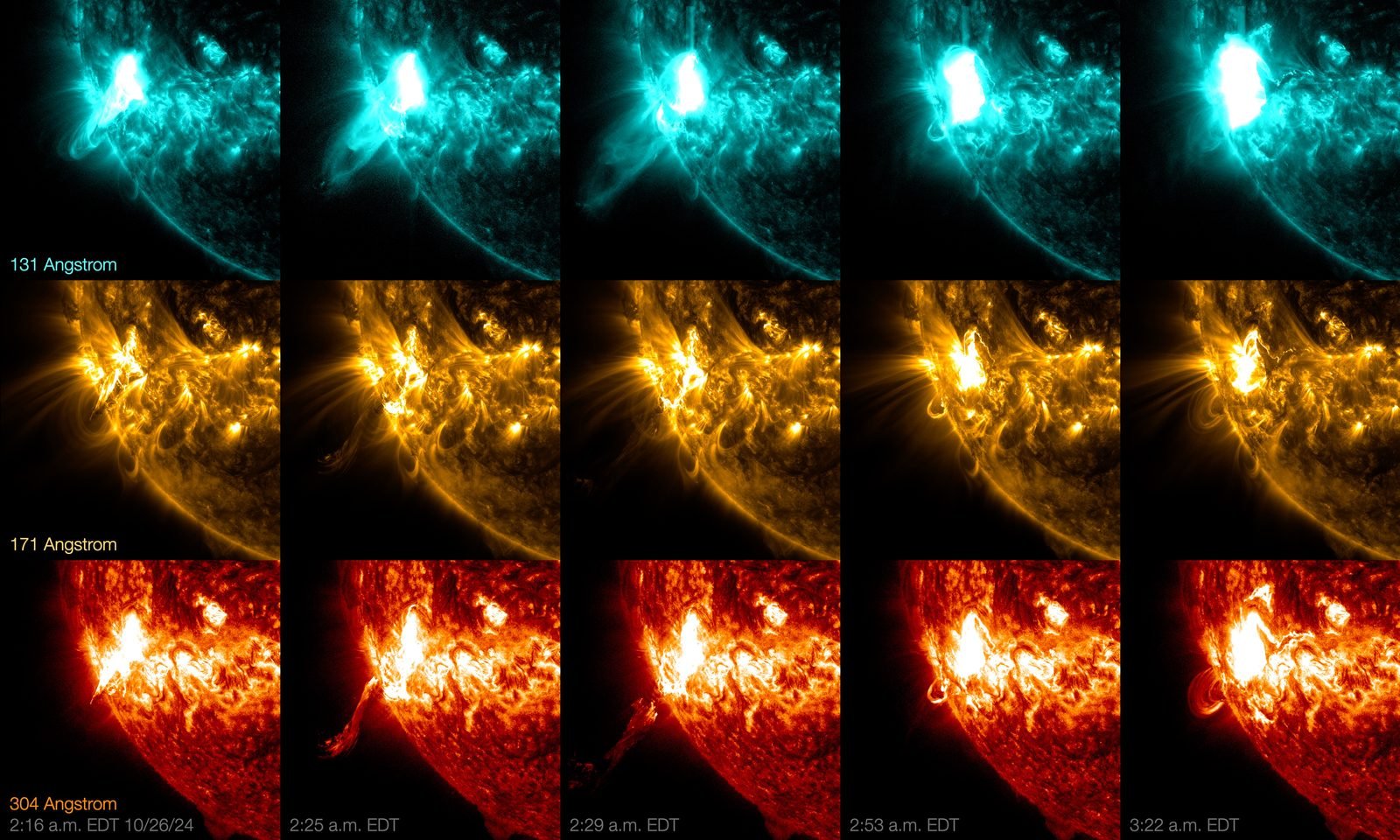
Fulguración solar de clase X vista en tres longitudes de onda del ultravioleta extremo.
Fulguración solar de clase X vista en tres longitudes de onda del ultravioleta extremo.NASA / SDO · Goddard Space Flight Center · Dominio público

Before the crisis

What NASA does document as a real possibility: geomagnetic storms induce electric currents in transmission grids, which can damage transformers, relays, and circuit breakers; strong flares can disrupt the high-frequency radio signals that travel through the upper atmosphere; and they heat and expand that atmosphere, increasing drag on low-orbit satellites, which then lose altitude.

  • No special preparation is needed beyond what you'd do for any other scenario: family plan, emergency backpack, and a reserve of water and food.
  • If you rely on GPS for work or driving, keep a physical map as a backup.
  • Follow only official space-weather monitoring sources: NOAA's Space Weather Prediction Center publishes verified alerts.
  • Be skeptical of any viral message announcing a "total blackout" on an exact date: space agencies warn with data, not social media rumors.
Official sources for this section

During the crisis

How to read NOAA's official scales. There are three independent scales, each measuring a different effect:

G Scale — geomagnetic storms (affects the power grid)
Runs from G1 to G5. At G3 there are intermittent satellite navigation problems. At G4 satellite navigation is degraded for hours. At G5, the most severe level, some power grid systems can experience complete collapse or blackouts.
R Scale — radio blackouts (affects communications)
Runs from R1 to R5. At R5, the most severe level, there is a complete high-frequency radio blackout across the entire sunlit side of Earth, lasting hours.
S Scale — solar radiation storms (affects satellites and aviation)
Runs from S1 to S5. At S5, satellites can be rendered inoperable, with possible permanent damage to their solar panels.
Official sources for this section

After the crisis

If your area experienced a power outage from a geomagnetic storm, the rules are the same as for any other blackout: check the power outage guide for food, generators, and dealing with cold or heat without electricity.

  • Check that GPS and navigation systems are working normally before relying on them for a long trip.
  • Report any electrical damage to your power provider, even if it seems minor.
Official sources for this section

Family plan

A family plan is not a pretty document: it is a handful of agreements made today, while everyone is calm, so you do not have to decide with your heart racing and no signal on your phone. It takes one conversation over the table and fits on a sheet of paper stuck to the refrigerator.

  1. Decide where to meet, in two different places. One near home, for getting out quickly, and another outside the neighborhood, in case you cannot get back to the area. Everyone should know both by heart, children included, and it should not depend on anyone having a phone handy.
  2. Name an out-of-area contact. One person in another city that everyone texts when they can. That person gathers information and passes it along, so no one has to go out looking for anyone else. It works because local lines get overloaded first, and because a text gets through where a call does not.
  3. Assign responsibilities to specific people. Who grabs the emergency bag, who shuts off the gas and power, who helps the older person or someone with reduced mobility, who gets the pets out. A task with no owner is a task no one does.
  4. Keep the list on paper. Phone numbers for family, the out-of-area contact, the doctor, the school, insurance, and emergency services. On paper, in the emergency bag, and in your wallet. A phone with a dead battery has no address book.
  5. Practice it once. A fifteen-minute drill reveals what the conversation does not: that the emergency bag was buried in the closet, that no one knows where the gas shutoff is, that the child does not remember the meeting point. Repeat it at least once a year and whenever something important at home changes.
Official sources for this section

Food and water

How to store it so it works when you need it
The CDC calls for approved food-grade containers with a tight-fitting lid, made of a sturdy, unbreakable material —never glass— and with a narrow mouth for pouring. An explicit warning: never use a container that has held toxic chemicals such as bleach or pesticides. And what almost everyone forgets: stored water should be replaced every 6 months. To disinfect the container before filling it, use a teaspoon of unscented household bleach per liter of water, wait 30 seconds, and pour it out.
What food to keep on hand
Ready.gov recommends several days of non-perishable food and gives a concrete list: ready-to-eat canned meats, fruits, and vegetables —and a can opener—, protein or fruit bars, dry cereal or granola, peanut butter, dried fruit, canned juices, and pasteurized long-life milk. The rule when putting it together is simple: food your family will actually eat, that needs no cooking, and that you can rotate before it expires.
  • Keep the refrigerator and freezer closed: every time you open one, you waste hours of stored cold.
  • Throw out any food that has touched floodwater, even if the container looks intact. This is an explicit Ready.gov instruction.
  • Keep a manual can opener. It is the item people forget most, and without it your pantry is useless.
  • If you buy bottled water, keep it sealed in its original container, in a cool, dark place.
Official sources for this section

Power and communications

When the cell network is overloaded: text, do not call
The joint FCC and FEMA guide explains why: "text messages may get through when your call does not", even if delivery is delayed when the network is congested. And it asks for something almost no one does: "limit non-emergency calls", because every call takes up space that emergency communications need. Also save a contact under the name "ICE" (In Case of Emergency), the convention rescue personnel look for on someone else's phone.
How to stretch your battery
The same guide recommends lowering screen brightness and turning off apps to conserve charge. In an emergency your phone stops being entertainment and becomes your only line to the outside world: treat it like your water supply.
The battery-powered radio is still irreplaceable
The FCC and FEMA recommend a battery-powered radio or a portable television to follow emergency bulletins during power outages. It is the only channel that depends on neither your electricity nor the cell network.
The alerts you already have and did not know about
In the United States, Wireless Emergency Alerts are free messages that go straight to your phone for severe weather, AMBER alerts, and threats to safety in your area. Two things worth knowing: you do not need to sign up —phones have supported them since 2012— and they are not affected by network congestion, so they get through when calls no longer do. Find out what the equivalent system is in your country, and do not mute it.
  • Have at least one light source that does not depend on the grid: a battery-powered or hand-crank flashlight, or a rechargeable lamp.
  • Charge phones and backup batteries before the forecast event arrives, not after the power is already out.
  • Keep a list of important phone numbers on paper: if your phone dies, your contacts die with it.
  • Agree with your family that after an emergency everyone texts the same contact instead of calling each other.
Official sources for this section

Health and special needs

This is the section that decides who has a hard time and who has a dangerously hard time. An emergency does not suspend diabetes, high blood pressure, pregnancy, or dependence on an oxygen concentrator: what gets cut off is access to the pharmacy, the clinic, and electricity. Everything that follows needs to be prepared beforehand, because once the emergency hits, there is no more room.

  1. Keep a reserve of your medications, and know which ones hold up. Ready.gov calls for a several-day supply of prescription medications. For those that need refrigeration, the CDC is blunt: once the power has been out for a day or more, discard any medication that requires refrigeration, unless its label says otherwise.
  2. The insulin exception, worth knowing word for word. The FDA documents that insulin in the manufacturer's original vials or cartridges —opened or unopened— can stay unrefrigerated between 15 and 30 °C (59 and 86 °F) for up to 28 days and still work. It loses effectiveness at extreme temperatures, and the longer the exposure, the less effective it becomes. In an emergency "you may still need to use insulin that was stored above 30 °C" —that is better than not using it at all— but as soon as proper storage is available again, those vials should be discarded and replaced.
  3. If someone depends on electric medical equipment, there is one step almost no one takes. Ready.gov says it explicitly: you can ask your power company to put you on a priority list for service restoration. That step is free, can be done on any ordinary day, and changes the order in which you get reconnected. Add a backup battery for an electric wheelchair and for any assistive device, and talk with your doctor about how to keep the equipment running during a power outage.
  4. Keep a copy of medical information, not just the pills. A list of medications with dosages, allergies, diagnoses, doctors' contact information, and —for infants— the vaccination record. A prescription bottle cannot always be refilled at a pharmacy in another city; a written list can solve that.
Pregnancy and newborns
The CDC calls for prenatal vitamins and other medications in the kit, plus supplies in case delivery happens without being able to reach a hospital: clean towels, clean sharp scissors, a bulb syringe, gloves, two clean white shoelaces to tie the cord, clean sheets, sanitary pads, soap or alcohol, and garbage bags. For infants: diapers, wipes, ointment, bottles, and formula. One detail that matters: ready-to-feed formula is the safest option in an emergency, because it does not need to be mixed with water and comes in sterile, single-use containers.
Disability, reduced mobility, and older adults
Ready.gov stresses planning accessible transportation in advance for evacuating or getting around, and including a service or support animal with its food, water, and supplies. That plan should be worked out with specific, named neighbors, not left vague.
The blow that comes later: mental health
The CDC names the normal reactions after a disaster —fear, anger, sadness, worry, numbness, frustration, trouble sleeping, or nightmares— and recommends taking care of your body, staying in touch with other people, and taking breaks from the news. In the United States and its territories, the Disaster Distress Helpline is available 24 hours a day: 1-800-985-5990, with service in Spanish. Asking for help here is not weakness: it is part of recovery, just like repairing the roof.
Official sources for this section

Home and belongings

  1. Before you go back in: look, smell, and listen from outside. The CDC lays it out this way: if you smell gas or suspect a leak, shut off the main valve, open all the windows, and get out immediately. If there is standing water inside and you can cut the power from a dry spot, do it. And one simple warning that prevents explosions and fires: use battery-powered flashlights, not candles, gas lanterns, or torches.
  2. Ventilate before you settle in. The CDC recommends going in briefly to open doors and windows, and letting the house air out for at least 30 minutes before staying inside.
  3. Shutting off utilities: when to do it, and the mistake you cannot make. Gas has a rule with no exceptions: if you shut it off for any reason, only a qualified professional can turn it back on. Never turn it back on yourself. Electricity is shut off by switching off the individual circuits first and the main breaker last —the order matters, because an electrical spark can ignite gas if there is a leak—. Water should be shut off if pipes may have cracked, because that contaminates the house supply, and should not be turned back on until authorities confirm it is safe to drink.
  4. Go back only when authorities say it is safe. It sounds obvious, and it is the instruction people break most often: go back home only when authorities say it is safe. Structural damage is not always visible from the street.
  • Make a photo inventory of what is in each room today: it takes twenty minutes and is worth its weight in gold for a claim.
  • Keep that inventory and your policies outside the house —in the cloud or with a family member— because a file that gets soaked along with the house is useless.
  • If you have to leave, take your documents with you, not your furniture.
  • Do not sign anything with a contractor while you are in shock: check the money section for the warning signs of fraud.
Official sources for this section

Money and income

The documents you need to protect today
The official recommendation is to keep insurance policies, deeds, property records, and other important papers in a safe place outside the house. FEMA publishes the Emergency Financial First Aid Kit for this, organized into four sections: household identification, financial and legal documentation, medical information, and contacts. Its rule for paper: a fireproof and waterproof box or safe, a bank safe-deposit box, or in the hands of someone you trust. For digital files: password-protected files on an external drive or in secure storage outside the home. And if you pay everything online, print your account records periodically.
An emergency fund, even a small one
The CFPB avoids magic formulas: "the amount you need depends on your situation", but "even a small amount can provide some financial security". Its underlying argument is the one that matters: without that cushion, a single unexpected expense can grow far larger than the original bill through interest and fees, because it forces you to rely on credit.
Official sources for this section

Economic opportunities

Adaptation and income
Time to start: Weeks

Home appliance repair

When replacing costs too much or stock runs out, fixing the fridge, fan or washing machine makes economic sense again.

Estimated investment: USD 50–500 Difficulty: media From home Tools needed
Time to start: Days

Selling rechargeable lamps, batteries and power banks

When the power is out for days, battery lamps, batteries and phone power banks sell out first. Local resale with a small margin and fast turnover.

Estimated investment: USD 50–600 Difficulty: baja From home

These are possibilities, not guarantees. Results depend on location, demand, competition, capital, skills and each person’s circumstances.

Filter the income possibilities by your situation. Results are starting points to research locally, not personalised advice. What can I do?

What you can sell

Adaptation and income

Here it's worth starting with what you should not sell, because this is the scenario that generates the most quackery on this entire site. NASA is explicit that a solar storm does not cause direct physical harm to people on Earth. Anything sold with a promise of "personal protection" against a flare is a fraud.

What does have legitimate demand is the same thing that helps during any extended outage, because the real, documented effect of a severe storm is on infrastructure, not on people:

  • Battery-powered or hand-crank radios and paper maps, for people who depend on GPS and the internet.
  • Battery backup power and surge protectors for sensitive equipment.
  • Data backups and advice for small businesses that keep their information only in the cloud.
  • General preparedness: water, food, lighting — the same as for any blackout.
Official sources for this section

Businesses and self-employment

Adaptation and income

It helps to start with one figure to size up what we're talking about: according to the ILO, informality affects nearly half of the employed population of Latin America and the Caribbean, around 47%, with huge differences between countries — under 30% in Uruguay and Chile, over 70% in Bolivia and Peru. For millions of families in the region, "looking for a job" and "starting something on your own" are the same sentence. What follows is not a promise of income: it is a map of what people actually do when a crisis hits, with the requirements and the risks laid out plainly.

Operational continuity for small businesses
Most small businesses don't have a copy of their data outside the cloud, and don't know how they'd take payment if their card terminal and internet went down. A service that puts that in order — a local backup, a written alternative payment plan, backup power for the essentials — is useful in a geomagnetic storm and in the far more likely things that actually happen every month.
Communication without the network
Selling and setting up battery-powered or hand-crank radios, and teaching people to tune in to their area's official stations. Minimal investment. It's worth selling for what it actually is — independence from the power grid and cell network in any emergency — not for the most dramatic scenario.
United States — SBA disaster loans
For areas with a declared disaster. The Economic Injury Disaster Loan (EIDL) provides working capital for affected small businesses and nonprofit organizations; the physical damage loan covers losses not covered by insurance. Combined cap of $2 million, interest not exceeding 4% if you cannot obtain credit elsewhere, terms of up to 30 years, and the first payment deferred 12 months. There is also a line for homeowners (up to $500,000) and for renters for personal property (up to $100,000).
Mexico — what actually exists today
FONDEN stopped taking on new commitments on January 1, 2021. What operates today in emergencies is PAEAN, run by Civil Protection, and it is worth knowing exactly what it is and is not: it delivers relief supplies — food kits, water, blankets, roofing sheets, cleaning materials — when a state's own capacity is overwhelmed. It is not a reconstruction fund or a loan for your business. For capital, look at state, municipal, or development-bank programs, always verifying on the official website: fraud schemes that use its name circulate around these programs.
Brazil — Pronampe for micro and small businesses
A credit line for microenterprises (annual revenue up to 360,000 reais) and small businesses (from 360,000 to 4.8 million). The amount can reach up to 60% of the previous year's gross revenue for businesses with more than one year in operation, and up to 50% for new ones. The maximum rate is the SELIC rate plus up to 6% per year.
Official sources for this section

Products and tools

Products and tools that could be useful

An orientation list to complement the information on this page. This is not a shop, and nothing here is a required purchase.

No products have been selected for this section yet.

Manuals and tutorials

PDF · manual

What-to-do manual: Solar Flare

Complete PDF guide to print or carry on your phone, with official measures before, during and after, and cited sources.

Checklists and templates

Downloadable materials for this section are not published yet.

Recovery stories

Real, published and verifiable cases: each one links to the source where it was documented. No made-up testimonials here.

Hydro-Québec (Canada) — nine hours in the dark and a redesigned grid afterward

The geomagnetic storm of March 13, 1989 tripped the Québec grid's protections at 2:44 a.m., in under a minute; the entire province lost power for more than nine hours. What mattered happened afterward: the utility recalibrated the protections by raising the trip thresholds, set up a real-time alert system to detect disturbances during magnetic storms, changed operating procedures — reducing flow through the lines and suspending major switching operations for the duration of the event — and installed series compensation on the lines. Since then, according to the utility itself, subsequent intense magnetic storms have not caused further outages.

What to learn from this: A solar event isn't "withstood," it's managed: the lesson here is that what prevented a repeat was anticipating and cutting the load during the storm, not new equipment. At home or in a business, the equivalent is having the warning (space-weather alerts), a plan for what you shut off first, and one night of self-sufficiency — because the outage hit while everyone was asleep.

Hydro-Québec · La tempête magnétique de mars 1989 — Comprendre l’électricité

Related articles

Three storms that mark the scale of the risk, from oldest to most recent.

Carrington Event, September 1–2, 1859 — the largest storm ever documented
It caused auroras visible as far south as Panama; there are accounts of people reading the newspaper by that night light. Telegraph systems around the world received shocks and stopped working. There's no figure for people affected, because in 1859 there was no power grid that could collapse. NOAA's official takeaway: an event of this magnitude occurs roughly every 500 years, a figure agencies use today to calculate the real risk to modern electrical infrastructure.
Quebec Geomagnetic Blackout, March 13, 1989
At 2:44 a.m., the Hydro-Québec power grid collapsed in under a minute. The province went completely dark for more than nine hours. The official lesson: Hydro-Québec recalibrated its protection systems, created real-time space weather alerts, and added series compensation to its transmission lines to withstand future storms — changes that are part of why the system held up better in 2024.

Related guides on this site:

Official sources for this section

Do not wait for it to happen

Download the checklist and build your family plan today. It takes under an hour and it is what changes the outcome most.